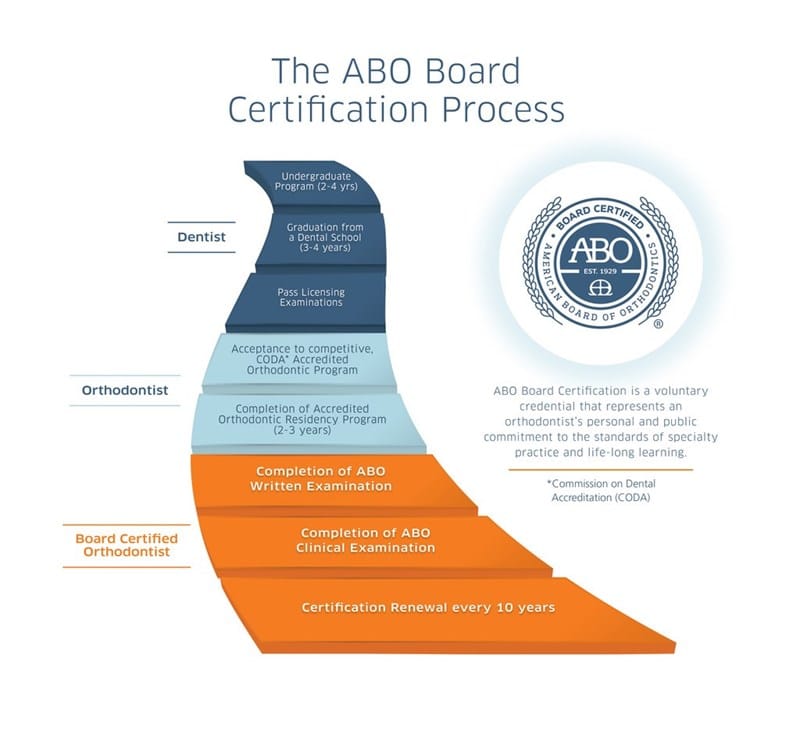
Are All Orthodontists Board-Certified?
No, not all orthodontists are board-certified. While every orthodontist must be licensed to practice, only around half pursue the additional credential of board certification. This prestigious certification, provided by the American Board of Orthodontics (ABO), represents a significant achievement that goes beyond the required two to three years of specialized education.
To earn board certification, orthodontists must:
- Present detailed case reports demonstrating their ability to treat a wide range of orthodontic issues with excellence.
- Prove their clinical expertise, decision-making skills, and comprehensive orthodontic knowledge through interviews conducted by a distinguished panel of examiners.
This certification is entirely optional and highlights a practitioner’s dedication to providing the highest standard of orthodontic care.
How Many Certifying Boards Are Recognized in Orthodontics?
Only one certifying board in orthodontics is recognized by the American Dental Association: the American Board of Orthodontics (ABO). Established in 1929, the ABO holds the distinction of being the oldest specialty board in dentistry. Its primary mission is to improve orthodontic care standards by promoting excellence through certification, education, and collaboration among professionals.
Why Do Orthodontists Pursue Board Certification?
Completing the voluntary board certification process signifies an orthodontist’s unwavering commitment to excellence in their profession. It reflects their dedication to providing top-tier orthodontic care and their determination to stay at the forefront of advancements in the field. For many orthodontists, achieving board certification is a point of pride, representing their dedication to the specialty and their determination to uphold the highest standards in patient care.
What Is Involved in the ABO Certification Process?
The ABO certification process, established in 1929, has evolved over time to align with advancements in orthodontics. Today, it includes several rigorous steps:
- Written Examination: A comprehensive test of 240 questions, covering all key areas of orthodontic knowledge.
- Clinical Examination: Candidates submit in-depth case reports from their practice or residency that illustrate their expertise in managing diverse and complex patient cases.
- Oral Examination: A panel of examiners reviews the submitted cases and tests the orthodontist’s academic and clinical expertise through detailed discussions.
Once these steps are successfully completed, the orthodontist achieves board certification, which is valid for a limited time. To maintain this distinction, orthodontists must renew their certification every 10 years by demonstrating ongoing excellence in patient care and staying current with advancements in the field.
For further information about The American Board of Orthodontics and Board Certification, click here.